Declarative
Workflow DSL
for
Define workflow pipelines in YAML. Execute your flow anywhere. Ideal for deterministic orchestration.
Design Philosophy
duckflux isn't "another DSL". It's an easy workflow engine for the 2000 century developers.
Declarative-first
Describe what your workflow should do. YAML is the source of truth: readable, version-controlled, diffable.
Deterministic
A state machine — not an LLM — controls flow. Your pipeline runs the same way every time. No hallucinated next steps.
Multi-runtime
The spec is implementation-agnostic. Same YAML, any runtime. Currently supporting any platform using binaries or Node/Bun environments.
Powered by Google CEL
Google Common Expression Language for all conditional logic. Type-safe, sandboxed, and battle-tested in Kubernetes.
Batteries included
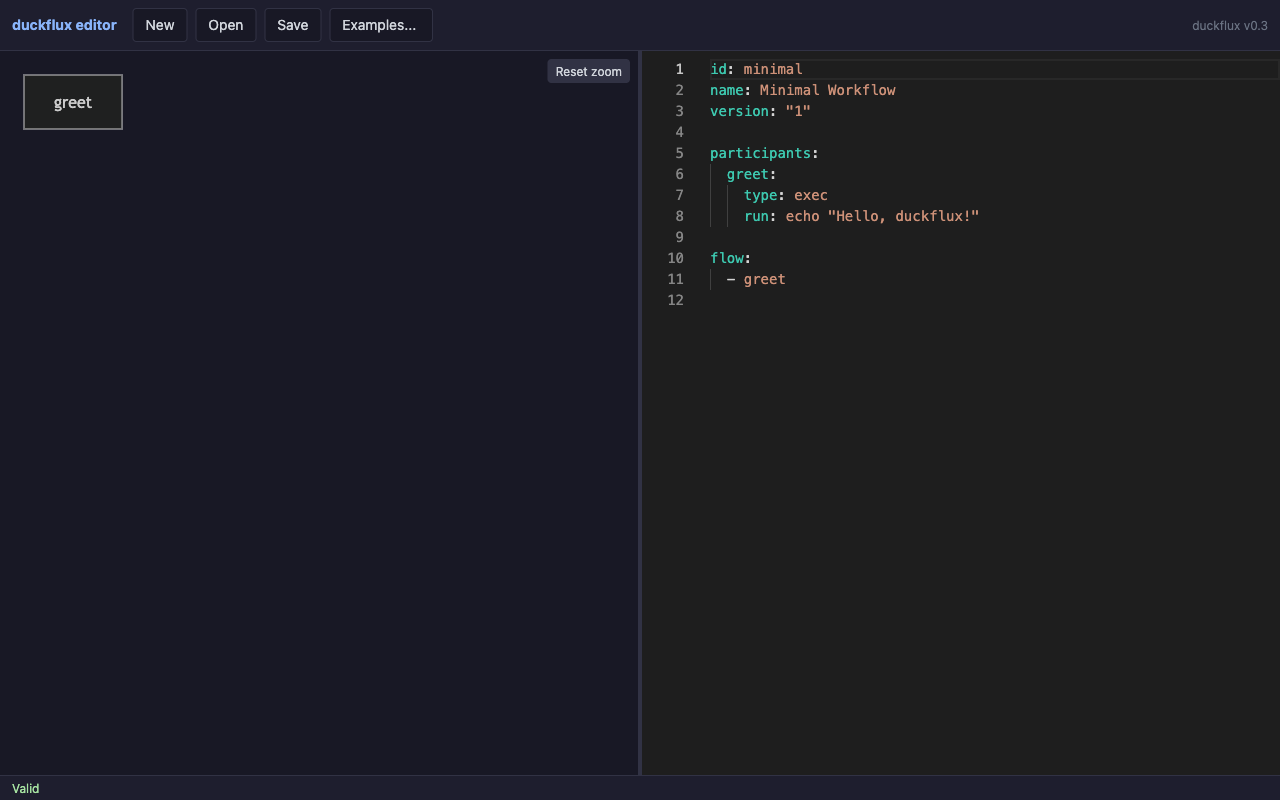
Redis, NATS and custom event hubs. A Mermaid-powered editor. A web server UI for observability.
Focused on DX
For developers without a PhD in distributed systems. Simple YAML with great capabilities.
Features
From simple scripts to complex multi-agent pipelines — duckflux speaks the same YAML regardless of complexity.
Powered by Google CEL
Google's Common Expression Language keeps your logic safe, predictable, and readable. The same engine that powers Kubernetes admission controllers.
steps:
  - run: analyze
    output: result

  - run: approve
    when: "result.score >= 0.9 && result.issues.size() == 0"

  - run: review
    when: "result.score >= 0.6 && result.score < 0.9"

  - run: reject
    when: "result.score < 0.6"
CEL expressions used
result.score >= 0.9 Direct field access with comparison
result.issues.size() == 0 CEL built-in: list length check
&& Boolean AND — both conditions must be true
Building Blocks
Every step in a duckflux workflow is powered by a participant. Six types cover everything from shell commands to event-driven coordination.
exec Shell commands & scripts
Execute any shell command, script, or binary. Perfect for AI agent CLIs, build tools, or custom runners.
Full exec referenceTooling & Ecosystem
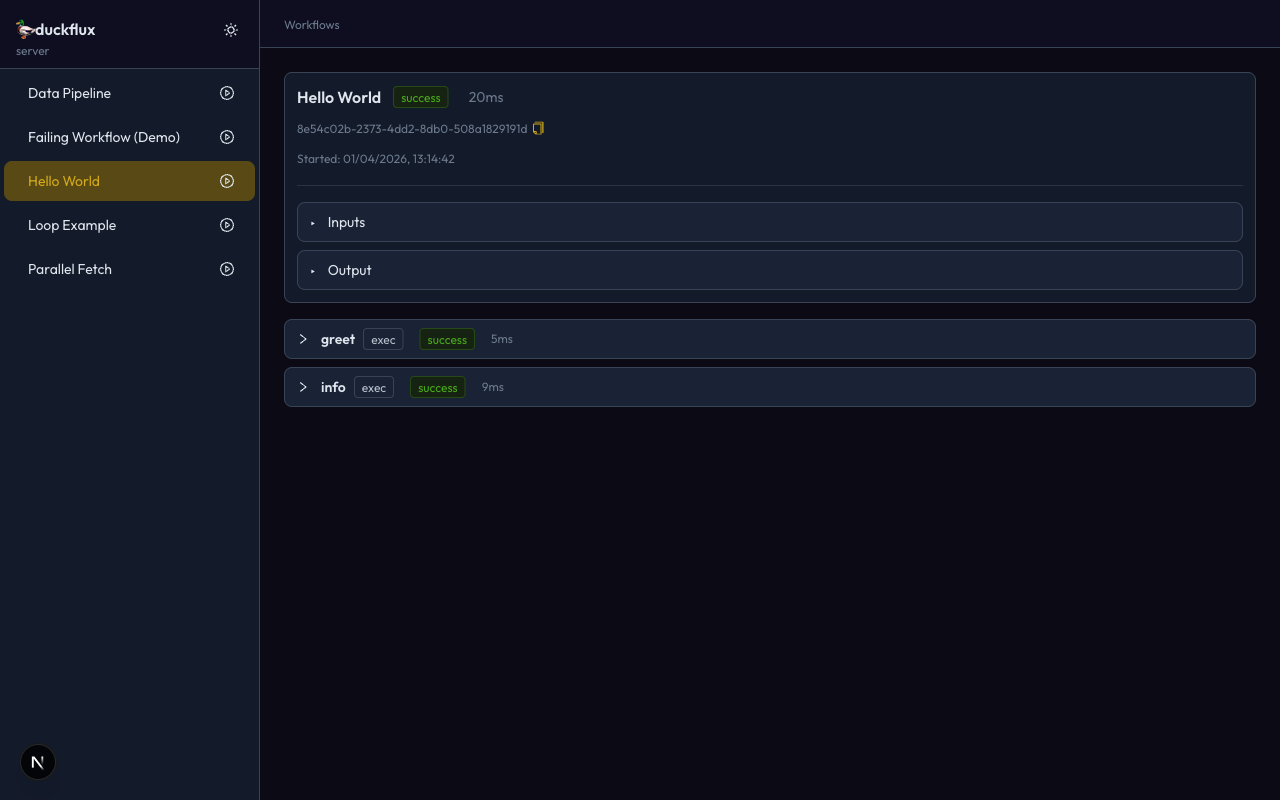
Everything you need to author, run, observe, and debug workflows — from the terminal to the browser.
CLI Run, lint & validate
Run workflows from the terminal with a single command. Lint for schema and semantic errors. Validate inputs before execution. Supports NATS and Redis event backends for cross-process coordination.
CLI reference# Install globally
bun add -g duckflux
# Run a workflow
quack run ./pipeline.duck.yaml --input repo=org/app
# Lint before running
quack lint ./pipeline.duck.yaml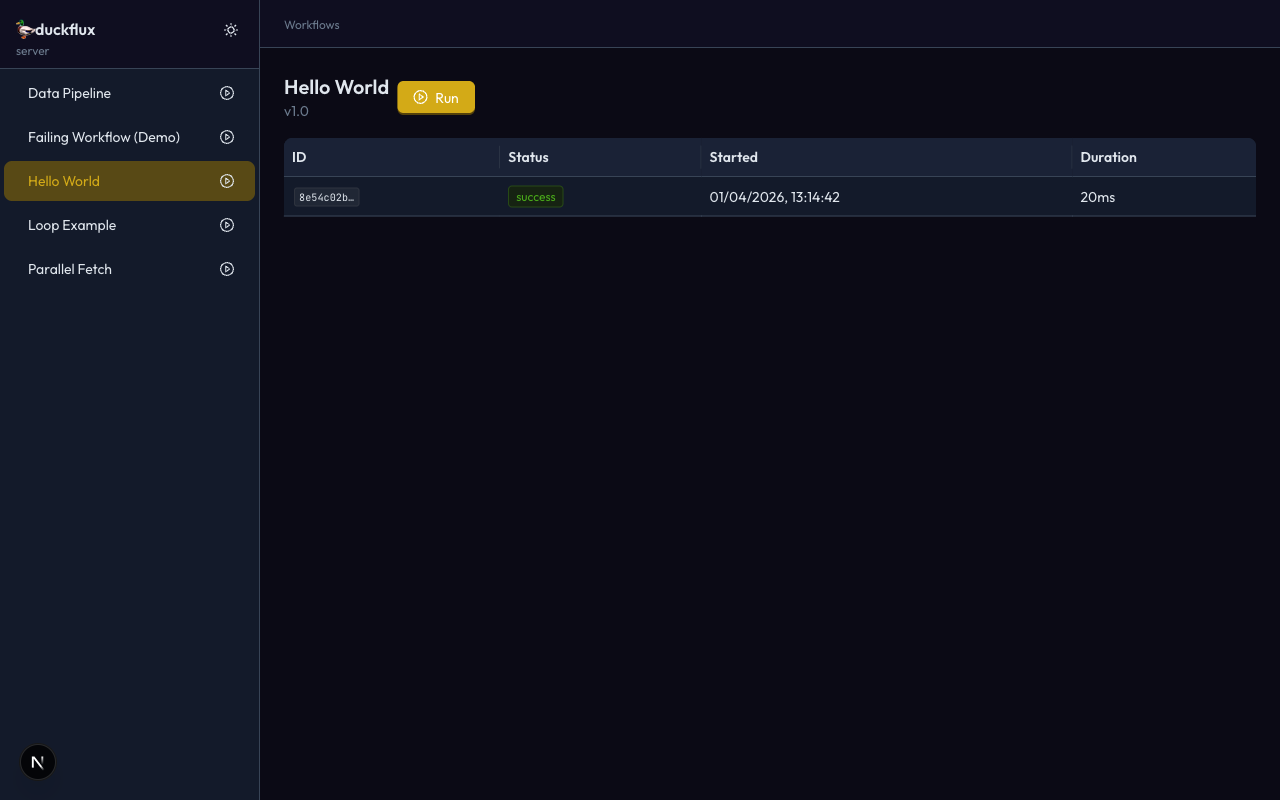
How duckflux Compares
The same workflow scenario across tools: a coder implements, a reviewer reviews, if not approved repeat up to 3 times, then deploy.
| Feature | duckflux YAML DSL | Argo K8s CI/CD | GHA GitHub CI | n8n Visual automation | Temporal Durable workflows | Airflow Data pipelines |
|---|---|---|---|---|---|---|
| Conditional loop | native | template recursion | unroll | JS hack | code | impossible |
| Fixed loop | native | native | ✗ | JS hack | code | ✗ |
| Parallelism | native | native | jobs | visual | goroutines | native |
| Conditional branch | native | when | if | IF node | code | BranchOp |
| Guard (when) | native | when | if per step | ✗ | code | ✗ |
| Events (emit/wait) | native | ✗ | ✗ | webhook | signals | sensors |
| Error handling | onError + retry | retryStrategy | continue-on-error | ✗ | code | ✗ |
| Sub-workflows | native | template ref | reusable | sub-workflow | child wf | SubDagOp |
| Spec is readable | ✓ | partially | partially | ✗ (JSON) | ✗ (code) | ✗ (Python) |
| Inline participants | native | ✗ | ✗ | ✗ | ✗ | ✗ |
Based on publicly available documentation. Table reflects capabilities, not quality.
Ready to quack?
Stop orchestrating
imperatively.
Write your first workflow in 5 minutes. Run it with a single command. Let duckflux handle the state machine so you can focus on what matters.
$ duck run ./hello.duck.yaml